Most startup discovery platforms begin after a company has already raised money, launched publicly, or appeared in someone else’s database. By the time a startup reaches Product Hunt, TechCrunch, LinkedIn, or a funding tracker, it is usually already visible to thousands of people.
VenturePing starts earlier.
Built by Floodlight Labs, VenturePing turns newly active domains into a compact daily feed of emerging startups, products, tools, publications, and side projects that are just beginning to show signs of life online.
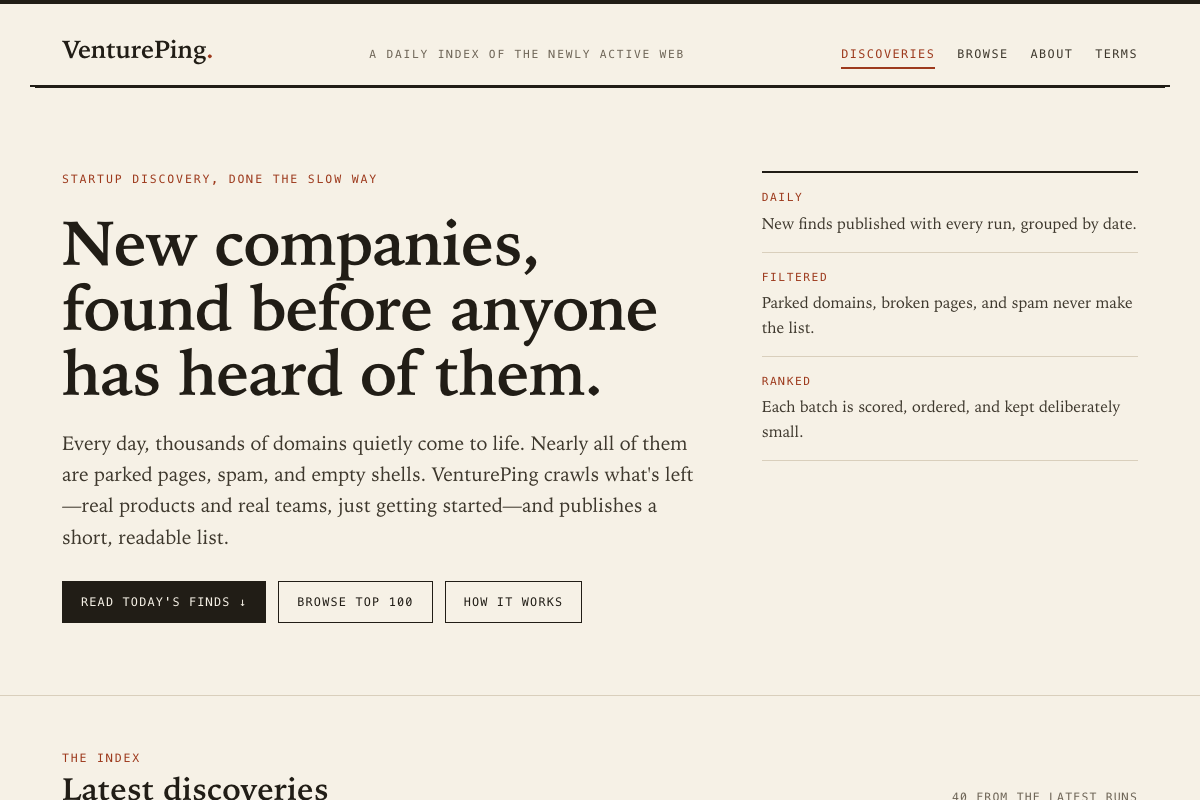
The idea came from a simple observation: the live web already contains a huge amount of early market signal. New companies appear on the internet every day, often quietly. A founder registers a domain, publishes a homepage, deploys a product, launches documentation, opens a waitlist, or starts describing a service before anyone outside a small circle knows it exists.
The problem is that the useful signals are buried beneath enormous amounts of noise.
Most newly active domains are not interesting. They are parked pages, spam, autogenerated sites, gambling pages, SEO farms, affiliate projects, placeholders, broken deployments, or abandoned experiments. The challenge is not finding domains. The challenge is filtering the internet into something worth reading.
That is what VenturePing is designed to do.
A feed instead of a database
VenturePing is intentionally not trying to become a giant startup database.
Large databases tend to become overwhelming and stale. They reward companies that are already good at visibility and marketing. They also create an endless-scroll experience where discovery becomes work.
VenturePing takes the opposite approach.
Every day produces a finite batch of discoveries: a small set of websites that appear to represent real people building real things. The feed is designed to be fast to scan and easy to revisit.
You can open the site, review the top discoveries from the day, notice recurring themes, and leave with a better sense of what kinds of products and businesses are starting to emerge online.
How the system works
VenturePing runs as a continuously operating domain discovery pipeline built around lightweight infrastructure and aggressive filtering.
The system starts with domain intelligence from UIDomains, another Floodlight Labs project that processes newly observed .com activity. UIDomains provides the raw discovery layer: trend terms, domain candidates, and early signals about what kinds of names are beginning to appear across the web.
VenturePing then turns that raw domain activity into a ranked discovery feed.
Early stages use heuristic scoring to eliminate obvious junk before deeper processing begins. Domains are scored using factors such as:
- Domain structure and naming quality
- Reachability and DNS behavior
- Content hints
- Trend term matches
- Hosting signals
- Spam indicators
- Crawlability
The first goal is simple: reject as much low-quality content as possible without wasting compute.
After initial scoring, remaining domains are crawled through a lightweight proxy setup hosted on home infrastructure. The crawler intentionally stays small and conservative. Pages are fetched with tight limits and lightweight extraction rules, usually only enough HTML and visible text to determine whether the site appears to represent a legitimate project.
This is not a large-scale archival crawler. The focus is classification and discovery, not indexing the entire web.
The content pipeline then removes:
- Parked domains
- Placeholder pages
- Thin affiliate sites
- Generic SEO spam
- Gambling and low-value content
- Broken deployments
- Empty templates
- Automatically generated junk
The remaining candidates move into final evaluation and ranking.
That stage runs on local language models hosted directly on a MacBook Air using Ollama. Instead of relying on expensive cloud inference infrastructure, VenturePing uses small local models to classify, summarize, reject, and rank candidate sites.
The hardware constraints become part of the system design.
Long evaluation runs generate thermal pressure on the machine, so the ranking pipeline intentionally processes candidates in small batches with cooldown periods between runs. Throughput is slower than cloud infrastructure, but operational cost stays extremely low and iteration speed remains high.
A typical nightly run looks something like this:
- ~6,700 candidate domains collected
- ~4,100 survive heuristic scoring
- ~2,500 pass crawl and content checks
- 868 reach final language-model evaluation
- 392 are accepted, ranked, and published
Most of the internet does not make the cut.
That filtering funnel is the product.
Built on practical infrastructure
The infrastructure behind VenturePing is intentionally simple.
The pipeline uses UIDomains for the domain discovery layer, a small proxy-based crawler for fetching candidate sites, a home server for hosting and orchestration, and a MacBook Air for local model inference.
The stack prioritizes practicality over architectural complexity:
- UIDomains for .com discovery and trend signals
- Node.js services
- Lightweight crawlers
- Proxy-based fetch infrastructure
- MySQL, Redis, and ClickHouse storage
- Local LLM inference through Ollama
- Automated nightly publishing pipelines
- Self-hosted publishing infrastructure
This constraint-driven approach shapes many of the product decisions. Instead of optimizing for maximum scale immediately, VenturePing is optimized for high signal density, low operating cost, and fast iteration.
The system is intentionally designed so that one person can continuously improve and operate it without requiring a large infrastructure budget.
Looking for patterns, not just companies
Individual discoveries are useful, but the more interesting part of VenturePing is the pattern that emerges over time.
As the system runs continuously, recurring themes begin to appear:
- New categories of AI tooling
- Changes in startup naming conventions
- Emerging workflows
- Infrastructure trends
- Shifts in product language
- Clusters of similar products appearing independently
Some signals are weak individually but become obvious in aggregate.
Over time, the feed starts behaving less like a startup directory and more like a lightweight sensor for what parts of the internet are beginning to move.
Building small systems that compound
VenturePing is part product and part experiment.
It explores how far a small, focused system can go when built around continuous operation instead of large teams or massive infrastructure budgets.
For Floodlight Labs, the project reflects a broader philosophy about software:
- Small surface area
- High signal density
- Utility over engagement
- Fast iteration loops
- Lightweight infrastructure
- Systems that improve through operation
The internet is still full of undiscovered projects quietly becoming real.
VenturePing is an attempt to notice them a little earlier.